


We develop deep learning models and applications for monitoring the marine environment.
Monitoring and analyzing the marine environment, be it through estimating abundance or classifying species in an ecosystem, is crucial for sustainable fisheries, harvests and environments. However, marine data is complex and is often challenging and time-consuming to analyze by hand.
By developing high quality deep learning methods which handle this inherently complex data, we provide the marine industries with data-driven solutions that automate and streamline these manual processes, contributing to improved resource management and less costs for our user partners.
Our deep learning research in the marine domain has produced several innovative solutions, enabling efficient and reliable tools for automatically analyzing complex marine data, including methods for:
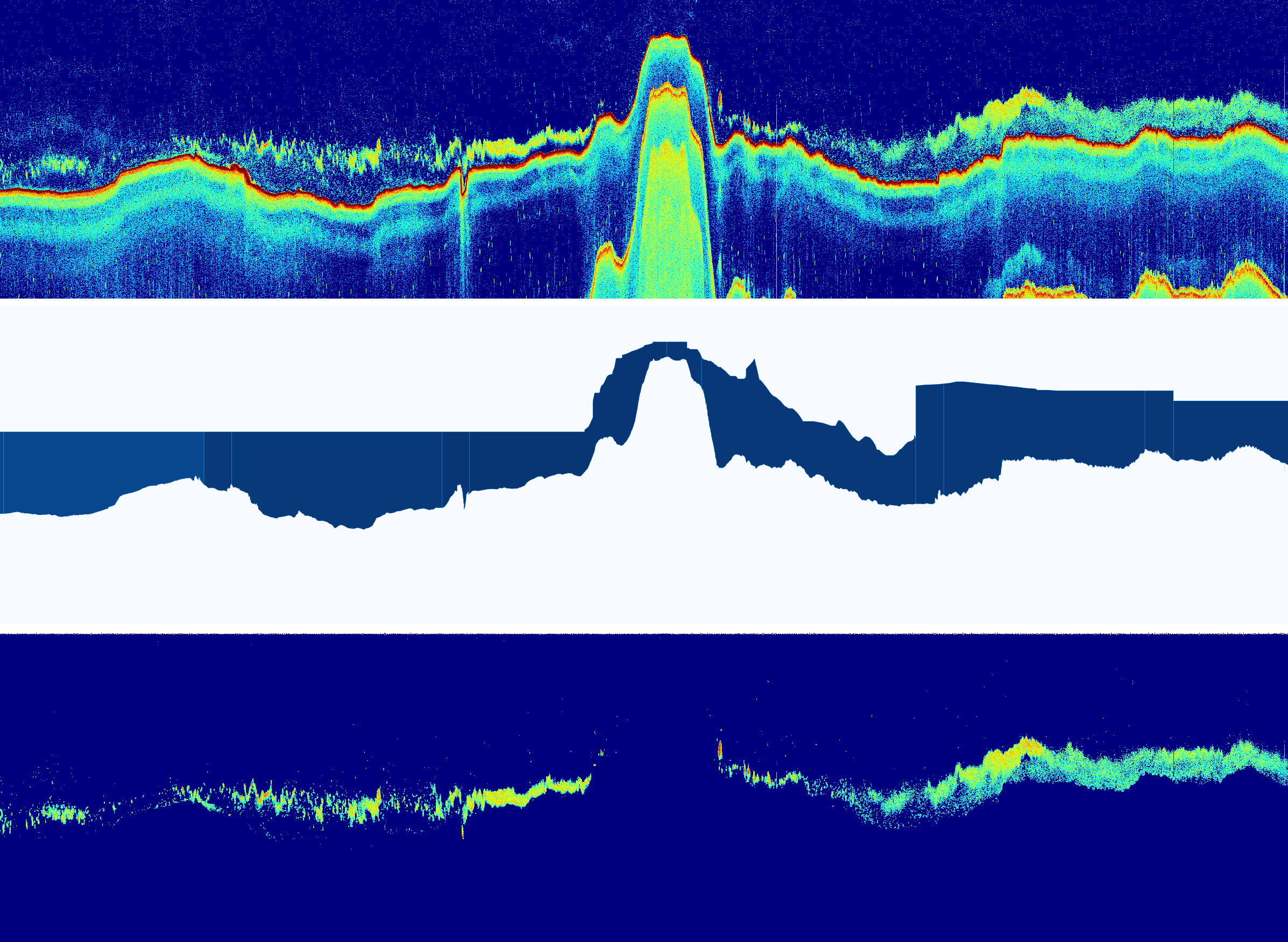
The method predicts acoustic herring energy at pixel level, enabling segmentation methods that learn from weakly labeled data, ultimately leading to more efficient and accurate abundance estimation. Read more.
This model identifies, locates and classifies seal pups on resting ice, providing a novel approach to calculating the abundance of sea mammals.
The method predicts uncertainty in various pre-trained networks, such as for segmenting sandeel from echosounder data, enabling more robust, reliable and trustworthy deep learning models for marine purposes.
The method utilizes weakly labeled data from herring surveys, providing more robust and reliable analyses of this type of marine data.
Such methods provide clearer insights into the decision-making of models designed for marine species detection and classification.
The above methods have been developed in close collaboration with user partner Institute of Marine Research.
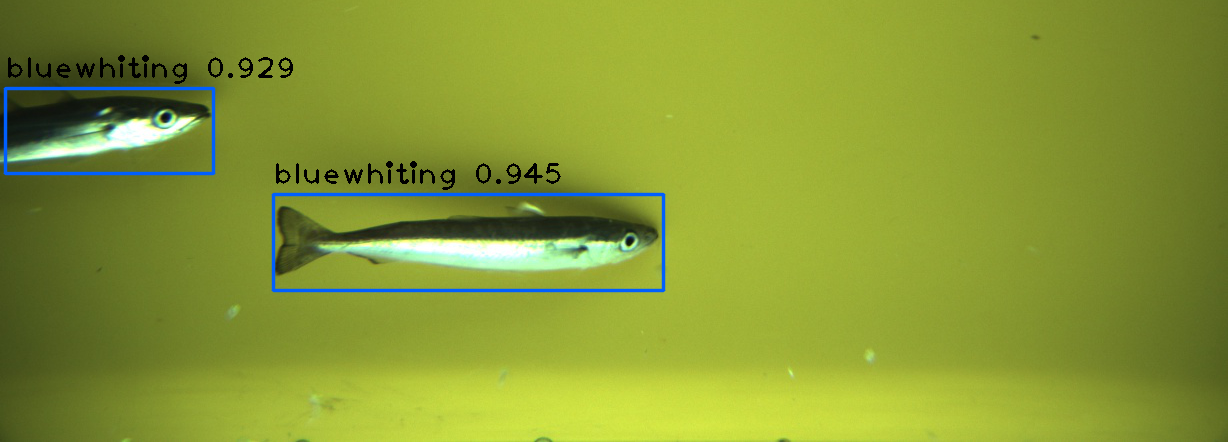
Developing deep learning for the marine sciences often involve challenges related to lack of labeled training data, a need for explainable and reliable models, and estimating the models’ uncertainty. Our innovations are developed with these challenges in mind.
Our semi-supervised method for detecting fish species is less dependent on labeled data, making efficient use of its training data.
The explainable marine image analysis methods enhance the accuracy of marine species detection, while providing better insights into its decision-making processes.

When developing deep learning solutions for marine applications, it is essential to transfer knowledge and methodologies across innovation areas. Our proposed methods synergize well with other work within this innovation area, as well as our other three innovation areas.
Our work on explainable marine image analysis has been validated on multiple marine image datasets, such as multi-frequency echosounder data from underwater environments and aerial imagery of sea mammals captured by drones. The explainability framework can therefore be applied to different marine datasets.
The method for quantifying uncertainty incorporated for sandeel segmentation can also be used across a variety of network architectures. This allows for potential transferability of methodologies across the innovation areas.
By authors:
Changkyu Choi, Michael Kampffmeyer, Nils Olav Handegard, Arnt-Børre Salberg and Robert Jenssen
Published in:
IEEE Journal of Oceanic Engineering
on
February 1, 2023
By authors:
Nils Olav Handegard, Line Eikvil, Robert Jenssen, Michael Kampffmeyer, Arnt-Børre Salberg, and Ketil Malde
Published in:
Journal of Ocean Technology 2021
on
October 6, 2021
By authors:
Changkyu Choi, Michael Kampffmeyer, Nils Olav Handegard, Arnt-Børre Salberg, Olav Brautaset, Line Eikvil, Robert Jenssen
Published in:
ICES Journal of Marine Science, Volume 78, Issue 7, October 2021, Pages 2615–2627
on
August 12, 2021