

.png)
August 17, 2026
We use gradient-based importance scores to reduce input features for deep-learning-based seasonal sea ice forecasting.
By Lars Uebbing, Doctoral Research Fellow at SFI Visual Intelligence
The extent of seasonal Arctic sea ice plays a pivotal role in the Earth's climate system. It also strongly influencing the accessibility of key shipping routes for global trade, wildlife migration, and other ecological and socioeconomic activities.
As a result, much effort has been put into the development of accurate sea ice forecasting methods. In particular, the publication of IceNet, a deep-learning-based forecasting model, which considers a variety of atmospheric climate observations together with historical sea ice concentration, has raised attention due to its precise predictions of anomalous sea ice extents. Follow-up studies have suggested that the model mostly ignores large parts of the provided input data (features) and only focuses on a small subset on which it bases its predictions.
In this study, we use these findings as a motivation to further investigate how the selection of input features influences the prediction quality of IceNet. To this end, we have used previous results to configure meaningful subsets of the original input features, reducing the number of features from 50 down to 10 in the smallest configuration. These different feature set have been used to train new instances of IceNet, which are comprehensively evaluated and compared against each other. In this evaluation, we emphasized a distinction between regular and anomalous sea ice extent.
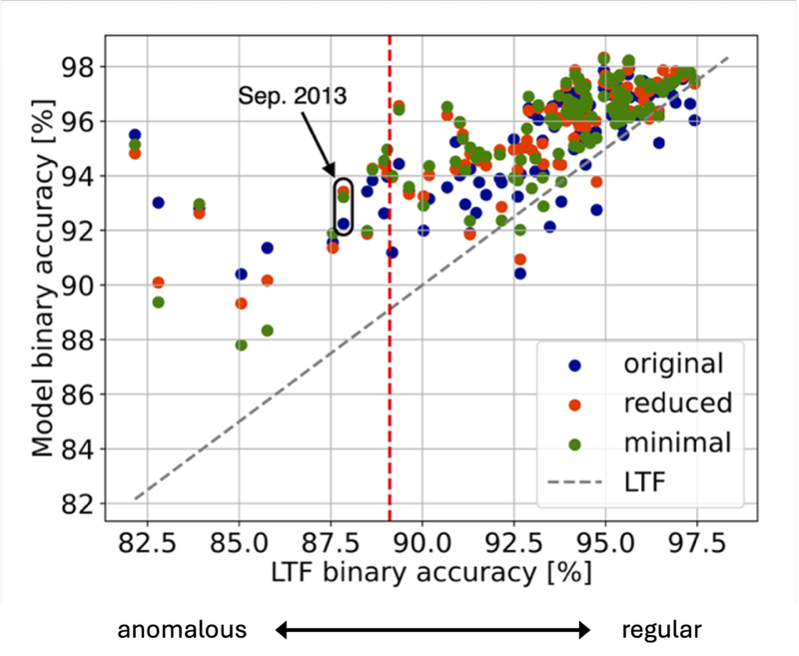
The right hand figure shows the accuracy of model predictions, resolved over the Linear Trend Forecast (LTF) accuracy. Each point corresponds to the prediction of a single month; color indicates which model it represents (number of features per model are original: 50, reduced: 21, minimal: 10). LTF represents a simple, non-ML baseline, forecasting sea ice based on linear trends the previous 35 years.
LTF accuracy is used as a measure for anomaly: The higher sea ice extent deviates from the LTF forecast, i.e. the lower the LTF accuracy, the stronger the anomaly of the sea ice extent. The dashed red line indicates the 10 % most anomalous months, which are represented by points on the left side of this line. Predictions for September 2013 are highlighted as this month was examined specifically in our and previous studies.
The results show a general performance increase when the input features are reduced to contain only derivatives of historical sea ice concentration. However, when it comes to anomalous events in the sea ice extent, the inclusion of the additional atmospheric features brings and advantage in most cases.
We interpret our findings as evidence how seasonal periodicity and previous sea ice concentration alone can be used to effectively forecast future sea ice extent. But at the same time, the results point to the importance of additional atmospheric features to explain and accurately predict deviations from regular sea ice extent.
January 1, 2026
Lars Uebbing, Harald Lykke Joakimsen, Luigi Tommaso Luppino, Iver Martinsen, Andrew McDonald, Kristoffer Wickstrøm, Sebastien Francois Lefevre, Arnt Børre Salberg, Scott Hosking, Robert Jenssen
With the state-of-the-art IceNet model, deep learning has contributed to an important aspect of climate research by leveraging a range of climate inputs to provide accurate forecasts of Arctic sea ice concentration (SIC). The deep learning subfield of eXplainable AI (XAI) has gained enormous attention in order to gauge feature importance of neural networks, for instance by leveraging network gradients. In recent work, an XAI study of the IceNet was conducted, using gradient saliency maps to interrogate its feature importance. A majority of XAI studies provide information about feature importance as revealed by the XAI method, but rarely provide thorough analysis of effects from reducing the number of input variables. In this paper, we train versions of the IceNet with drastically reduced numbers of input features according to results of XAI and investigate the effects on the sea ice predictions, on average and with respect to specific events. Our results provide evidence that the model generally performs better when less features are used, but in case of anomalous events, a larger number of features is beneficial. We believe our thorough study of the IceNet in terms of feature importance revealed by XAI may give inspiration for other deep learning-based problem scenarios and application domains.


Lars Uebbing, Harald Lykke Joakimsen, Luigi Tommaso Luppino, Iver Martinsen, Andrew McDonald, Kristoffer Wickstrøm, Sebastien Francois Lefevre, Arnt Børre Salberg, Scott Hosking, Robert Jenssen
Proceedings of the 6th Northern Lights Deep Learning Conference (NLDL), PMLR 265:245-254, 2025.
January 1, 2026